|
Trillium Antiquarian Books Some common memento is better, Something he prized and is known by; His old clothes-- a few books perhaps.
William Carlos Williams, Tract
Welcome to the home of Trillium Antiquarian Books where you can search or browse our collections of antiquarian books on Country Life and Natural History -- scarce books, from A to Z, on angling, animals, apiculture, bees, birds, botany, Darwin, farming, fish, flora, fruit growing, gardens, geography, grapes, herbals, horticulture, landscapes, mammals, orchards, ornithology, seeds, vegetables, wildflowers, zoology... and likely several other matters which do not come readily to mind.
Search and browse, too, our antiquarian Canadiana and Literature collections. In our Canadiana collection you will find the early works of Moodie, Traill, Davies, Bouchette, and others from Upper and Lower Canada. Our antiquarian Literature collection makes room among its novels, sermons, and poetry for some rare works by Mark Twain and Stephen Crane.
Sometimes all that's left of an old book is the pictures. You will find antiquarian prints and maps, together with entire illustrated books, in Trillium's collection of Images from antiquarian sources.
If you spend any time hunting up books, you are bound to come upon an occasional book so odd or idiosyncratic as to be irresistible. Proof of the proposition is to be found in the Trillium collection of intriguing Curiosities. Since their comings and goings are unpredictable, it's usually worth stopping in for a short browse.
Trillium Antiquarian Books has been selling scarce, out-of-print books on the Internet since 1998 and, earlier, by traditional mail order. Look for us at book fairs in Ontario and the American northeast, where we have exhibited during the past ten years or so. We are always interested in buying antiquarian books in our areas of interest, whether single volumes or complete collections.
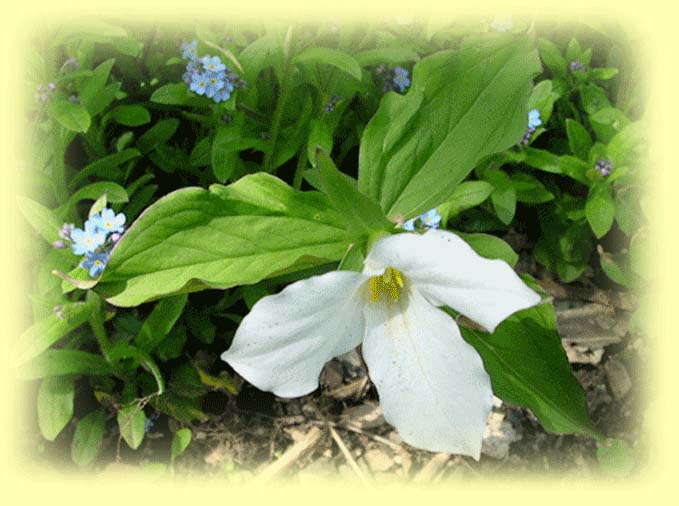
Trillium Antiquarian Books is owned by William Van Nest, Peterborough, Ontario, Canada. Trillium Grandiflorum, from which we take our name, is the provincial flower of Ontario and appears in snowy white drifts among the hardwoods each Spring. One of several trilliums resident in the back garden furnished the images on this page.
A SUPPRESSED REPORT
Introduction
Rumours have circulated for some years now among senior members of the antiquarian book trade that the original report by Isaac I. Stevens, Governor of the Washington Territory, entitled Route Near Forty-seventh and Forty-ninth Parallels in 1853-55, which comprised part of the larger Explorations and Surveys for a Railroad Route from the Mississippi River to the Pacific Ocean (1860), had in fact been suppressed by the federal authorities and an alternate text and illustrations representing a more ‘acceptable’ version of the findings produced in its stead. It has been suggested that neither the scientific community of the day nor the citizenry at large would have found credible the report’s unusual findings concerning the natural history of the new region in the American northwest.
An Archive
I have recently acquired a small archive, comprising the substitute text published at Washington, DC, by what seems to have been a special governmental committee. With a single exception the original plates have been excised, but no new plates inserted in their place. There are in addition some manuscript notes describing the subjects of those original illustrations. Likely, then, the archival contents represent the re-worked version of the text of the suppressed report with notes on the original illustrations. The List of Illustrations (pp. 29- 30) in the new text suggests what the seventy or so substitute illustrations might have been (e.g., ‘Flathead Lake Looking Southward’). Significantly these new illustrations are typically of the generic, topographic sort such as ‘Sauk River’, ‘Pike Lake’, or ‘Near Mouse River’ and might have been drawn as much from imagination as from life. They suggest no new or unusual discoveries but rather an array of comfortable, familiar scenes. Strong evidence of the government revisionists’ intentions.
The Manuscript Notes
While no doubt incomplete, the manuscript notes (a single fascicle bound with a bit of string) are all but certainly the source from which the suppressed plates were prepared. They furnish salient details of various species of flora and fauna discovered resident in the region between the forty-seventh and forty-ninth parallels in the course of Governor Stevens’ explorations. Furthermore, they suggest an ecosystem capable of supporting forms of life quite unlike those familiar to most Americans of the day, whether of a scientific bent or not. The ms amounts to damp-stained field notes, hastily written by several hands. Several pages have suffered some loss. However, once these challenges to interpretation had been overcome, there emerged an account of a number of species to this day all but unknown to the scientific community.
Transcriptions
For purposes of identification and analysis the discrete parts of the manuscript have been separated by subject and numbered consecutively. In some cases the scattered observation data has been arranged in natural sequence and certain explanations which seemed in order have been interpolated. Take all together, these notes might form the basis for a new, if partial set of plates similar to those redacted by federal authorities in the mid-nineteenth century.
I. Fauna
(1) Mountain Giraffe or Camel Leopard. Markings similar to the plains-dweller, but with short, stout legs and neck. Presumably as a mountain dweller, it would have no need to see over tall grasses and shrubs while a taller profile would subject the animal to unwanted buffeting by strong mountain winds. Thick, finely matted hair underlies long, draping guard hairs not unlike the coat of the yak.
(2) Clockwise Mountain Sheep. Ranges, or circles, through the mountains in a clockwise direction, is identified by longer legs on its left side to facilitate climbing in its chosen direction. Similar to but not directly related to animal described in (I.3) below.
(3) Counter-clockwise Mountain Sheep. Ranges through the mountains counter-clockwise and is identified by longer legs on its right side. These two varieties of sheep rarely interbreed as their opposite directedness and leggedness render mating unusually awkward and, if attempted on a too narrow stoney shelf or at the edge of a crevasse, potentially fatal.
(4) Semi-carnivorous Rabbit. A large, hare-like rabbit the size of a beagle, it has long, silky angora-like fur. Prefers carrion but occasionally feeds on voles and ground-squirrels; in Winter this rabbit feeds on dried grasses and other plants carefully stored underground in special chambers in extensive burrow complexes where several dozen of these rabbits may over-winter. Largely crepuscular, actively seeks carrion at dawn and dusk.
(5) German-Speaking Unicorn (?). While it is well-known that accounts of unicorns, their behaviour and their metaphysical significance, are always in the first instance composed in German (and therefore are printed in old-fashioned Gothic-style type, or Fraktur), these field notes record native unicorns speaking in what the observer believes to be a Germanic dialect. In this place, though, the manuscript is somewhat damaged and the notes of the observer (who was not a German speaker) are sketchy. It is, nevertheless, an intriguing possibility.
(6) Effulgent Nighthawk. Similar to the Eastern Nighthawk (caprimulgidae) in appearance and general habits, it feeds almost exclusively during periods of the full moon, perhaps relying on bright moon light to help locate its insect prey. Usually a retiring bird, it becomes very active as the cycle of the moon matures when large flocks seek out mosquitoes, blackflies, and gnats.
(7) Bipolar Bear. This large bear, often as large as the grizzly, is characterized by the unpredictability of its behaviour which varies from a light-hearted, almost euphoric playfulness (The animal has been observed sliding down long, snow-covered mountain slopes or gaily tossing a captive fish high into air) to extreme irritability (For no apparent reason Bipolars fall into vicious quarrels and may be severely injured in the course of the fight). These large, impressive bears have two colour phases. The dense coat of a happy-go-lucky individual is white to dingy yellow, but it swiftly (sometimes within a few hours) turns to brown, descending into nearly pure black as the animal’s mood changes. Such rapid shifts in the animal’s state of mind and pelage tire the animal, and bipolars sleep a great deal.
(8) Figure-Eight Snake. Quite a large snake (up to 2 m), about the size of the American Black Snake, marked by red and yellow longitudinal stripes the length of it body, the Figure-Eight Snake feeds on fallen fruit and slow- moving creatures such as worms and torpid grasshoppers. It is not a fast-moving snake, no doubt in part due to its habit, which seems to develop early, of moving everywhere in figure-eights. This snake, even when newly hatched, instinctively slides its body into the form of a pretzel, a configuration it maintains until, dying, it at last straightens itself out.
(9) Singing Duck. It is the female of this flightless species which sings; its repertoire includes a variety of melodies familiar to those who enjoy jolly French folk songs. For the most part they are contraltos, although there is a great deal of variation of voices within that range. The male utters an occasional quack or a thin whistle (like that of our Wood Duck). The female Singing Duck is rather larger than the male and, unusual for ducks, is the wearer of striking plumage-- iridescent splashes of emerald green, copper, and gold. Its wings are sky blue. The sober male wears a white bib over its sprinkled gray and brown plumage.
(10) Blueberry Beetle. A large, glistening blue-black beetle, weighing as much as ten kilograms, it feeds exclusively on blueberries, both leaves and fruit, and can be found in the high blueberry meadows which stretch along mountain sides and thread down along river valleys. The beetle feeds by moving slowly and methodically in a straight, unvarying path across a field of berries, consuming every leaf and berry as it goes. Seen from some distance, these insects appear to be mowing half-metre wide strips across a berry meadow. They are the chief competitor of the Bipolar Bear for the blueberry harvest. The large whitish bears toss the beetles to and fro like children with a ball; the darker bears seem either infuriated at their presence, lashing the bushes with their enormous claws, or sulk, depressed by their rivals’ persistence. A Blueberry Beetle, with its 3 cm thick exoskeleton, is seldom troubled, and when the bear tires of its play or exhausts its angry energy, carries on mowing as though nothing has happened.
(11) Ice Sturgeon. A large (3 m) fish that in Winter permits itself to be frozen into a solid block of ice for the duration of the season. When active it forages the bottoms of lakes and large rivers, seeking shellfish and decayed matter of all sorts. Spawning pairs of Ice Sturgeons put on enthusiastic displays-- leaping together, their entire length, straight out of the water where, in an instant, they become entwined before falling as one back into the water with a mighty splash. Eager but inexperienced young Ice Sturgeons also display, sometimes with comic effect.
II. Flora
(1) Hair Tree. A large tree characteristic of the northwest (30 m). As with several very old tree species, like the Gingko, there are male and female Hair Trees. The Male Hair Tree is nearly bald, rather like our bald cypress. The female Hair Tree, however, found both in curled and weeping varieties, sports luxurious pale green foliage all year ‘round. The massive foliage of the Female Hair Tree, whether curled into myriad green clusters or draped in long, ground sweeping branches not unlike a weeping willow, is a favourite nesting place for a number of bird species, including the Northwest Robin. Sometimes a dozen or more active nests are found in a single Hair Tree (especially the curled variety). The small yellow fruit of the Hair Tree is said to be nutritious and favoured by many animals.
(2) Blazing Synchronized Sunflower. Two metres high with showy red foreground petals and golden yellow background petals. This remarkable flower grows in vast stands in open meadows across the northwest. A true sunflower, the entire plant in an instant at midday turns 180 degrees to catch the westering sun. Growing in vast plantations as they do, the daily simultaneous head-turning by thousands of sunflowers animates an otherwise quiescent landscape. In the evening once the sun has set, the Blazing Sunflower gradually turns back to the East to greet the rising sun. The plant seeds itself in a similar way. All of its seeds mature at exactly the same time and all of them are expelled at once; where upon, the plant's cycle complete, it dies within minutes. Some mountain meadows in Autumn are carpeted with the expired plants.
(3) Strangling Anger Vine. Has been known to kill several fully grown Hair Trees before succumbing to its own wrath. A scarlet red vine, perhaps 3 cm in width, it wraps itself in tight loops around and around the Hair Tree, beginning halfway up the trunk, until the entire Hair Tree disappears beneath the red vine and eventually collapses from the weight of its attacker. Nesting birds are sometimes caught in the vine’s embrace and they too are killed. The Strangling Anger Vine has no known enemies except of course for itself. These vigorous growers do not distinguish, say, between a Hair Tree and another Strangling Anger Vine and begin growing ‘round the one as eagerly as the other. Sometimes a Hair Tree is saved when two vines competing for the same tree mistakenly wind themselves around each other, both eventually perishing in the effort.
(4) Putrid Puffball. Like the eastern puffball but uniformly large, the size of a soccer ball. They appear in dense masses over night, and after a week or so upon maturation release immense masses of spores. Pigs and other large creatures which disturb the mushroom plantation are liable to be struck unconscious by noxious exudent emitted by the puffballs. Unlike common puffballs, the Putrid Puffball is not edible, even by the French.
(5) Yellow Baffle Grass. A thick, luxurious grass which while growing only to a maximum height of 12- 15 cm, grows so thick and soft animals of all sorts seek it out as a favoured lying up place. Great patches of Baffle Grass absorb every sound but that of the wind, and even great tempests are quieted by the grass. There are no other movements to be heard; the baffle grass prairie is a nearly silent world. Here any animal many take its rest and none other disturb it.
Note on a Surviving Plate
One original plate entitled ‘Council with Whiteman’s Horse’ survives in the text (p. 89). Oddly, no horses are depicted and so the meaning of the scene is unclear. Perhaps the white man’s horse is out of the frame listening to the discussion before making his or her own contribution; perhaps the individuals shown in conversation are preparing their remarks prior to meeting with the horse somewhere in its pasture; it is even possible the illustrator (Stanley) mistook the purport of the scene all together and pictured humans rather than horses in council. In any event, the sole surviving plate suggests the magnificent scale of the country and the manner of its original artistic treatment.
Where Did They Go?
Certain skeptics have wondered aloud what became of the flora and fauna described in Stevens’ report. Why, they ask, are there no survivors to suggest what may have gone before? Reasonable explanations are not hard to come by. Plainly, for example, as settlers moved into the region in ever larger numbers, the Hair Trees were cut to clear the land for agriculture and burned in enormous bond fires. With the Hair Trees all but extirpated, the Strangling Anger Vine turned exclusively upon itself and eventually was wiped out by its own efforts. Many of the native animals moved north, out of the region, into Canada where there was no one to bother them. Certainly large, playful white bears are still found in the Canadian arctic. The flightless Singing Duck was a strong swimmer and walker; no doubt large flocks of the birds gathered to begin the watery trek north into Canada, singing as they went.
William Van Nest
December 2011
|